Home › Exercise and strength training
Exercise and strength training
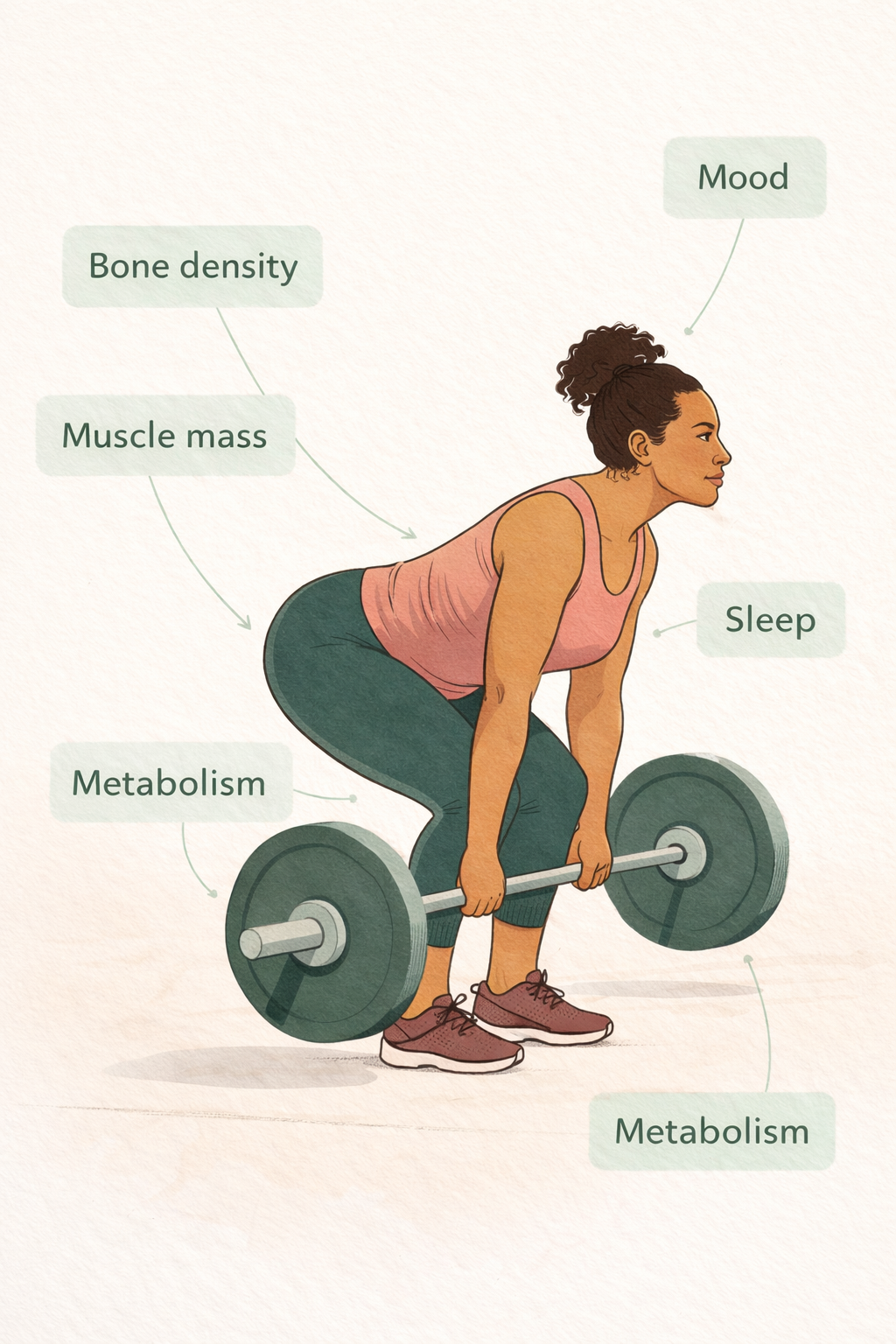
The single most evidence-backed lifestyle intervention for menopausal health — and the one most women are not doing enough of. Resistance training addresses bone density, muscle loss, metabolic health, mood, cognitive function, and cardiovascular risk simultaneously. Nothing else comes close.
Rose
"If I could tell every woman in perimenopause one thing — one thing above all the research I have done — it would be this: pick up some weights. Not to look a certain way. To keep your bones strong, your muscle mass intact, your metabolism working, and your mood stable. The evidence is overwhelming and I wish I had known this sooner."
Why exercise matters more at menopause
3-8% per decade
Muscle loss accelerates
Estrogen supports muscle maintenance. Its decline accelerates sarcopenia — age-related muscle loss. By postmenopause, without intervention, women lose muscle mass and strength at a rate that significantly affects function and metabolic health within years.
20% in 5-7 years
Bone density falls sharply
The first years after menopause see the most rapid bone density loss of a woman lifetime. Mechanical loading from exercise — particularly resistance training — is the most effective non-pharmaceutical stimulus for maintaining bone density.
Significant shift
Metabolic rate slows
Muscle is metabolically active tissue. As muscle mass declines, resting metabolic rate falls — making weight management progressively more difficult. Resistance training rebuilds and maintains the metabolic engine.
Doubles in a decade
Cardiovascular risk rises
Estrogen protects the cardiovascular system. Exercise — particularly aerobic and resistance training combined — provides direct cardiovascular benefits that partially compensate for the loss of estrogenic protection.
The four types of exercise — what each one does
💪
Resistance training
Strong evidence
Weights, resistance bands, or bodyweight exercises that challenge muscles to work against resistance. The most important form of exercise for menopausal women — period. Builds and maintains muscle mass, stimulates bone formation, improves insulin sensitivity, supports posture, and reduces injury risk.
Evidence-backed benefits
• Increases bone mineral density — the most effective non-pharmaceutical intervention
• Builds and maintains lean muscle mass that estrogen decline is removing
• Improves insulin sensitivity — directly counteracting menopausal metabolic changes
• Reduces hot flash frequency in some women
• Significantly improves mood and reduces depression risk
• Improves sleep quality
• Reduces all-cause mortality risk
How to start
Aim for 2-3 sessions per week. Focus on compound movements that work multiple muscle groups — squats, deadlifts, rows, presses, hip hinges. No gym required to start — bodyweight squats, lunges, push-up variations, and glute bridges are highly effective. A single session with a trainer experienced in menopause fitness is worth the investment to learn form. Progress by adding weight or difficulty every 2-4 weeks.
🚶
Aerobic exercise
Strong evidence
Walking, cycling, swimming, dancing — sustained movement that raises heart rate. Essential for cardiovascular health and mood. Should complement resistance training not replace it. Many women in menopause do plenty of cardio and not enough resistance training — the priority should be reversed.
Evidence-backed benefits
• Cardiovascular protection — reduces the risk that rises sharply at menopause
• Mood improvement — aerobic exercise raises endorphins and BDNF (brain-derived neurotrophic factor)
• Sleep quality improvement with regular practice
• Hot flash reduction in some women
• Cognitive protection — aerobic exercise supports brain health and memory
How to start
Aim for 150 minutes of moderate intensity per week — that is 30 minutes five days. Walking briskly counts. Swimming, cycling, and dancing all count. The key is consistency over intensity. Even 10-minute walks add up meaningfully.
⚡
High-intensity interval training (HIIT)
Mixed evidence
Short bursts of intense effort alternated with recovery periods. Growing evidence for metabolic benefits and time efficiency. Some menopausal women find it worsens cortisol and sleep — individual response varies significantly.
The honest picture
HIIT is effective and time-efficient. But for women with poor sleep, high stress, or elevated cortisol — which describes many perimenopausal women — very high intensity exercise can worsen cortisol further and disrupt sleep. If you feel wired and exhausted after high-intensity exercise, that is a signal to reduce intensity and increase resistance training and walking instead.
If you want to try it
Start with 1-2 sessions per week maximum alongside your resistance training. Monitor how you sleep and how you feel 24 hours after. If sleep worsens or fatigue increases, dial back intensity before frequency.
🧘
Yoga, Pilates, and flexibility work
Mixed evidence
Mind-body practices with evidence for hot flash reduction, mood improvement, joint mobility, and stress. Valuable as a complement to resistance training. Yin yoga and restorative yoga are particularly useful for the recovery and parasympathetic activation that menopausal women often need.
Where to start
YouTube — Yoga with Adriene, Brett Larkin, and many others offer menopause-specific programs free. Pilates classes or online programs provide structured progression. Aim for 2-3 sessions per week alongside resistance training.
A realistic starting plan
If you are starting from nothing
Week 1-2 — Build the habit
3 x 20 minute walks. 2 x 15 minute bodyweight sessions (squats, glute bridges, push-ups against a wall, step-ups). The goal is showing up, not intensity.
Week 3-4 — Add resistance
Introduce light dumbbells or resistance bands. Increase walk duration. Add one yoga or stretching session. Focus on learning movement patterns with good form.
Month 2 onwards — Progressive overload
Increase weight or difficulty every 2-4 weeks. Aim for 2-3 resistance sessions and 150 minutes of walking or cardio per week. This is the sustainable long-term pattern.
What to look for in a trainer or class
Ask specifically about experience with perimenopausal and postmenopausal women. Look for trainers who understand bone density, pelvic floor considerations, and the role of cortisol management. Avoid trainers who primarily push high-intensity boot camp style training for menopausal women without considering recovery. Online programs specifically designed for menopause are available — search for menopause strength training or perimenopause fitness.
A note on pelvic floor
High-impact exercise — running, jumping, HIIT — can worsen urinary incontinence and pelvic organ prolapse in women with pelvic floor weakness. This is extremely common and rarely discussed. If you leak when you exercise, see a pelvic floor physiotherapist before assuming you need to avoid high impact permanently. Most women can return to any exercise they want after appropriate pelvic floor rehabilitation.
Rose on this
"The research is clear: the women who age best are the ones who lift weights. Not heavy weights necessarily — progressively challenging weights. The muscle you build in your 50s protects your bones, your metabolism, your mood, and your independence for decades. It is never too late to start — and never too early."
From Rose
"Your body is not betraying you — it is changing. And the response to change is not to protect yourself from effort but to meet it. The women who feel best in postmenopause are almost always the ones who moved through the fear and picked up the weights. You can be one of them."
Written by

Founder & Editor · Living through perimenopause · rosemyfriend.com
Research basis
PubMed · Cochrane reviews · NICE guidelines · British Menopause Society · The Menopause Society
Read methodology →
Rose provides evidence-graded educational information — not medical advice. Always discuss health decisions with a qualified healthcare provider.
Full disclaimer ·
About Rose